

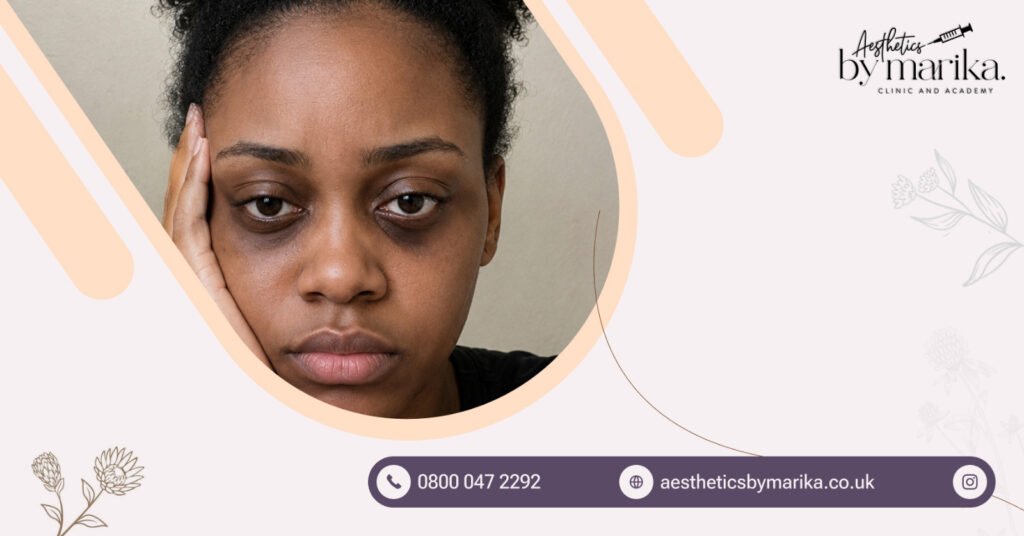
One thing we hear all the time at Aesthetics By Marika in Enfield, North London is:
“I’m getting enough sleep, so why do I still look tired?”
And honestly, sometimes sleep has very little to do with it.
You can be getting your eight hours, drinking plenty of water and feeling absolutely fine, but still look tired when you look in the mirror. This is because what we associate with a “tired face” can actually be caused by volume loss, under-eye hollows, changes in the mid-face and skin quality.
So if concealer, skincare and an early night aren’t making much difference, there may be another reason.
Why Your Face Can Look Tired Even After a Good Night’s Sleep
A lot of what we perceive as ageing or tiredness comes down to light and shadow.
When we’re younger, the cheeks tend to be fuller and the transition between the lower eyelid and cheek is smoother. This allows light to reflect more evenly across the face.
As we age, we naturally lose some facial volume and structural support. Hollows and deeper contours can develop, particularly underneath the eyes and through the mid-face.
These areas create shadows – and those shadows can make the face appear tired even when you’re feeling completely rested.
This is why sometimes more sleep simply isn’t the answer.
Mid-Face Volume Loss Can Make You Look Tired
Ageing isn’t only about wrinkles.
Over time, changes occur within the skin, facial fat compartments and underlying bone structure. We also gradually lose collagen and elastin.
The cheeks can therefore start to look flatter and less supported, while folds around the mouth may become more noticeable.
This is something I explain to clients all the time: sometimes the area bothering you isn’t necessarily the area we need to treat first.
And the under-eye area is the perfect example.
Cheek Filler Before Tear Trough Filler – Why?
If you have hollow or tired-looking eyes, you might automatically assume you need tear trough filler.
But not everyone does.
The under-eye and cheek areas are closely connected. If you’ve lost volume through the mid-face, there may no longer be enough support underneath the tear trough.
In these cases, I will often recommend cheek filler first to restore some of that mid-face support.
Once the cheeks have been treated, we can reassess the under-eye area. Sometimes improving the cheeks alone makes a noticeable difference to the appearance of the tear trough. Other clients may still benefit from carefully placed tear trough filler afterwards.
This is why I don’t believe in simply injecting the area a client points to. The face needs to be assessed as a whole.
What Causes Dark Circles Under the Eyes?
Dark circles aren’t all the same either.
They can be caused by several factors, including:
* Genetics and pigmentation
* Thin under-eye skin that makes underlying blood vessels more visible
* Loss of volume and structural hollowing, which creates shadow
* Skin quality and dehydration
* Lifestyle factors and lack of sleep
And sometimes it’s a combination.
This is important because tear trough filler won’t correct every type of dark circle. If pigmentation is the main issue, for example, adding filler isn’t going to remove the pigment.
A proper assessment helps us work out what is actually creating the darkness before recommending treatment.
Can Dehydrated Skin Make You Look Tired?
Absolutely.
When the skin is dehydrated, dull or lacking in collagen, it doesn’t reflect light as well. The complexion can look flatter, less radiant and generally less healthy.
This is where treatments focused on skin quality rather than facial volume can be really useful.
Depending on the individual, I may recommend treatments such as Profhilo, polynucleotides, Plenhyage XL, microneedling or other skin rejuvenation treatments to improve hydration, texture and overall skin quality.
The aim isn’t necessarily to change how you look. Sometimes it’s simply about making your skin look fresher, healthier and more radiant.
When Skincare Isn’t Enough
I am a huge believer in good skincare, but it’s also important to understand what skincare can and cannot do.
A good routine can support your skin barrier, hydration, pigmentation and general skin health.
However, a moisturiser cannot replace lost cheek volume, and a serum cannot restore deeper structural support to the face.
If the issue is primarily structural, you can spend a fortune changing skincare products without ever achieving the result you’re looking for.
That’s when we may start discussing injectable or collagen-stimulating treatments.
Which Aesthetic Treatments Can Help a Tired-Looking Face?
There isn’t one treatment that works for everybody, which is exactly why consultation and facial assessment are so important.
For some clients, dermal filler may be appropriate to restore lost volume in areas such as the cheeks, soften certain folds or, where suitable, treat the tear trough.
For others, Sculptra may be more appropriate. Sculptra is a collagen-stimulating injectable treatment, so rather than simply adding immediate volume like traditional dermal filler, it encourages your body to gradually produce more collagen.
If skin laxity and texture are more of a concern, Morpheus8 radiofrequency microneedling may be considered to stimulate collagen and improve skin firmness and texture.
And if the main concern is dull, dehydrated or ageing skin, skin boosters or polynucleotides may form part of the treatment plan.
Often, the best facial rejuvenation results aren’t achieved by throwing one treatment at everything. It’s about choosing the right treatment for the right layer of the face.
The Bottom Line
If you’re constantly being told you look tired when you actually feel perfectly fine, don’t automatically assume you need more sleep – or more concealer!
It could be related to under-eye hollowing, mid-face volume loss, skin quality or a combination of several factors.
And importantly, if your main concern is your under-eyes, that doesn’t automatically mean tear trough filler should be your first treatment. Sometimes restoring support to the cheeks can make far more sense.
At Aesthetics By Marika in Enfield, North London, every face is assessed individually before I recommend a treatment plan. My aim is always to work with your natural facial anatomy and create a refreshed, balanced result rather than simply treating individual areas in isolation.
If you’re unsure what’s making your face look tired, you can book a consultation at our Enfield aesthetics clinic and we can assess your skin, facial structure and concerns properly before deciding which treatment – if any – is right for you.
